

If you’ve typed “Best ERP Software Company in Bangladesh” into Google, you’re probably past wondering if you need an ERP. You already know it. The real question is which local vendor actually understands how business gets done here? And then here comes our explanation. First we need to know what actually an ERP stands for and what this can do in a business.
What Is an ERP Software Company in Bangladesh?
An ERP Software Company in Bangladesh builds, implements and supports Enterprise Resource Planning systems. It also works for platforms that connect accounts, inventory, sales, procurement, production and HR into a single system. And specifically for businesses operating under Bangladeshi tax law, banking practice and industry conditions.
The Three Types of ERP Providers You’ll Run Into
Before comparing specific companies, it helps to know the categories “ERP” covers wildly different products wearing the same label.
1. Global enterprise ERPs, SAP, Oracle NetSuite, Microsoft Dynamics
Powerful, well documented, built for large organizations with in-house IT teams. Implementation in Bangladesh usually runs into lakhs to crores of taka and many months. But you’ll still need a local implementation partner, because the vendor itself isn’t configuring your NBR VAT return.
2. Open-source and generic cloud platforms, Odoo, Tally-based systems
Flexible and relatively affordable to start. Odoo especially has a strong footprint in Bangladesh through local implementation partners. Flexible usually means you or your partner build the Bangladesh-specific and industry-specific pieces yourselves. Fine then, if you have the technical capacity to maintain that long-term, a real cost if you don’t.
3. Locally built ERP companies
This is where most Bangladeshi SMEs, real estate developers, manufacturers and trading houses end up, because the product is designed around local workflows and compliance from day one. This category includes sector-focused entrants like CLARRA ERP by iTech Velocity.
Within this category, the real differences come down to which industries a vendor actually specializes in, how deeply modules connect to the chart of accounts, and how support behaves once you’re a paying client instead of a prospect.
| ERP Type | Strength | Watch Out For |
| Global enterprise ERP (SAP, Oracle, Dynamics) | Powerful, well-documented, built for scale | High cost, long rollout, needs a local partner anyway |
| Open-source / generic cloud (Odoo, Tally-based) | Flexible, lower starting cost | You or your partner build the BD-specific pieces yourselves |
| Locally built ERP (CLARRA ERP, and other BD ERP companies) | Built around NBR VAT, local workflows, faster go-live | Depth varies by vendor — check industry specialization |
How to Evaluate an ERP Software Company in Bangladesh (Before You Sign Anything)
Most ERP comparisons online are feature checklists. Checklists are close to useless, almost every vendor will say yes to “does it have inventory management.” Ask these instead.
- Is it built for your industry, or adapted to fit it? Ask the vendor to demo your actual industry workflow, not a generic pitch — a real estate module bolted onto a generic ERP behaves differently from one designed around land acquisition and instalment booking from day one.
- Does everything post to your chart of accounts automatically? If sales, procurement and payroll don’t post directly to accounts in real time, you’re still reconciling by hand at month end, which defeats the point of buying an ERP at all.
- Where does your data actually live? Ask directly whether data is processed on the vendor’s own infrastructure or routed through third-party AI services. This matters more with every ERP now shipping some form of AI assistant.
- What does support look like after go-live? “24/7 support” often means a ticket portal with a 48-hour window. Ask for the real escalation structure, a named account manager, a direct line, a stated first-response time.
- Can your team use it from a phone on a slow connection? For site managers, warehouse staff and field sales teams, browser-based access rather than an app-store download and forced version updates is a genuine day-to-day difference, not a nice-to-have.
- Is pricing built around what you need, or a fixed package? A vendor that explains, module by module, what you’re paying for is a better sign than one quoting a flat number before understanding your business.
- Is the company registered, certified and easy to verify? BASIS membership (Bangladesh Association of Software and Information Services) is a reasonable baseline signal, worth checking directly rather than assuming.
Where CLARRA ERP by iTech Velocity Fits In
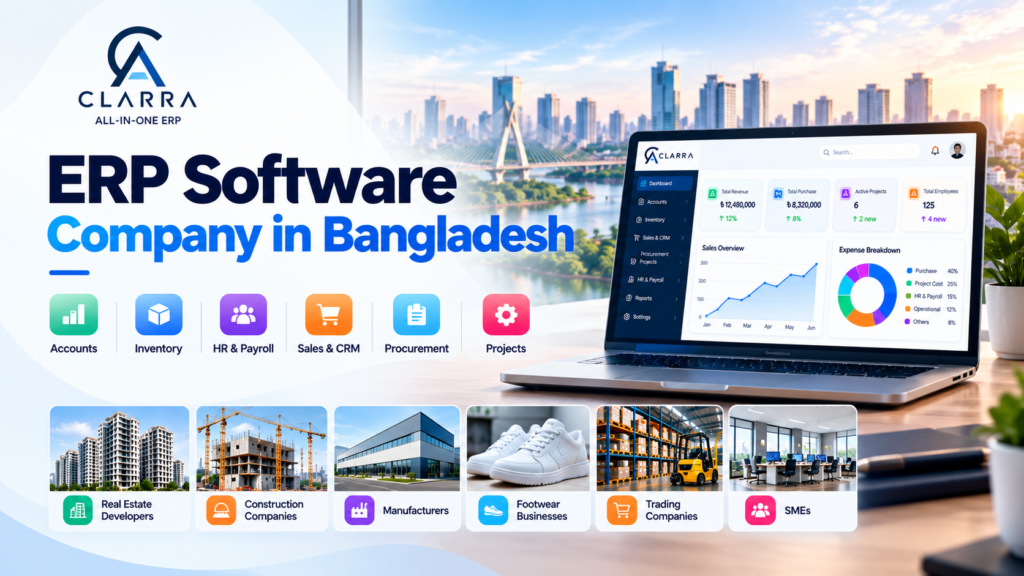
CLARRA ERP is built by iTech Velocity, a BASIS-certified software company headquartered in Niketon, Gulshan-1, Dhaka. iTech Velocity was founded in 2025 with a narrow, specific goal: build ERP software around how real estate developers, construction firms, manufacturers, footwear businesses and trading companies in Bangladesh actually operate, instead of adapting a system designed for somewhere else.
Here’s what that looks like in practice.
Everything posts to your chart of accounts, automatically
Every module, engineering and budget control, supply chain, sales and collection, production, HR and payroll, posts directly to the chart of accounts. There’s no separate accounting module other departments feed manually; accounting is the backbone everything else is built on. That’s what removes the month-end scramble.
It’s a Progressive Web App, not a native download
Open a browser, log in, and the full system works, phone, tablet or laptop, Android or iOS, no app-store download, no forced updates. For site supervisors and field teams on inconsistent connections, this decides whether the system gets used at all.
Your data stays inside your own system
CLARRA ERP’s internal AI agent processes data within the client’s own system rather than routing it through external servers. For a business handling financial records, client data and employee information, which is every business, that’s a meaningfully different security posture.
Support includes a dedicated account manager, from day one
L1 through L5 support, a named account manager, WhatsApp support, phone support, on-site visits and refresher training, built into the relationship, not sold as a separate tier.
Industry-built modules, not generic templates
- Real estate, construction and housing: Land acquisition and plot inventory, flat and plot booking, automated instalment collection with overdue tracking, floor-wise construction progress against budget, and contractor billing.
- Housing and land-share businesses: Partner entitlement tracking, flat allocation, shared-expense settlement, partner-wise profit-sharing reports — a niche most generic ERPs skip entirely.
- Manufacturing: Production planning, material requirements planning (MRP), multi-level bills of materials, real-time product costing.
- Leather and footwear: Order-wise production from cutting to finishing, size- and colour-wise inventory, process-level costing per style.
- Trading and SME: Full purchase-to-sales cycle, multi-location stock visibility, POS integrated with accounts, modules that scale from a 10-person trading business to a multi-project developer.
CLARRA ERP currently serves businesses across Bangladesh, the UAE, Saudi Arabia and Kuwait, and is headquartered at House #118, Level-4, Road #9, Block C, Niketon, Dhaka-1212.
ERP for Real Estate and Construction Companies in Bangladesh
This gets its own section because real estate and construction are two of the most underserved industries by generic ERP software here. A developer needs project budget control tied to real site progress, land acquisition tracking that reflects how land deals and share agreements actually work locally, flat and plot booking with instalment schedules stretching years — not months — and contractor billing that doesn’t live in a separate spreadsheet.
Most global ERPs treat “real estate” as a vertical they can support with enough customization. A locally built system with land-share partner accounting and floor-wise construction tracking already native saves months of configuration, and avoids the gaps that only surface after go-live.
ERP for Manufacturing and Footwear Businesses in Bangladesh
Manufacturers and footwear producers face a different core problem: knowing the true cost of what they’re making, in real time, not at month end. That needs MRP that actually prevents overstocking and stockouts, multi-level bills of materials that account for labour and overhead, not just raw material, and production tracking granular enough to show size- and colour-wise inventory. Generic ERPs handle basic inventory fine; they tend to fall short on process-level costing that reflects how a real cutting-stitching-finishing line moves.
What Does ERP Software Cost in Bangladesh?
There’s no single market rate, and any vendor quoting a fixed number before asking about your business isn’t giving you a real quote. Cost depends mainly on:
- Number of users — How many people will be logging in day to day.
- Number of modules — A trading business needs far fewer than a multi-project developer.
- Implementation complexity — How much your current workflows need to be mapped and configured before go-live.
- Support tier — Whether you need a dedicated account manager and on-site visits, or ticket-based support is enough.
The practical way to get an accurate number is a demo where the vendor walks through your actual workflow and quotes based on what you’ll use, not a generic package.
Frequently Asked Questions
What is the best ERP Software Company in Bangladesh for real estate and construction?
Look for a vendor whose ERP was designed around real estate and construction workflows specifically, land acquisition, flat and plot booking, instalment collection, contractor billing, rather than a generic ERP with a real estate module added on. CLARRA ERP by iTech Velocity is built specifically for serve enterprise clients across multiple sectors in Bangladesh.
How much does ERP software cost in Bangladesh?
It varies by number of users, number of modules and implementation complexity — there’s no fixed market rate. Most local ERP companies, including CLARRA ERP, quote after understanding your business size and industry rather than selling a flat package.
Is cloud-based ERP or on-premise ERP better for a business in Bangladesh?
Cloud-based ERP is accessible from any device through a browser with no local server maintenance, which suits most SMEs, real estate firms and trading companies. On-premise ERP needs in-house IT management and is usually only worth the overhead for larger enterprises with existing infrastructure and specific compliance needs.
Is my business data safe with a Bangladeshi ERP Software Company?
It depends entirely on the vendor’s architecture. Ask specifically where your data is processed and stored, and whether any AI features send data to external servers. Some systems, including CLARRA ERP, run AI processing internally rather than through third-party AI services, which removes that specific risk.
Can small businesses in Bangladesh afford ERP software?
Yes — modern ERP platforms are modular. A small trading business or SME can start with just accounts, inventory and basic HR, and add more as it grows, instead of paying for enterprise-scale functionality upfront.
What ERP modules does a real estate company in Bangladesh actually need?
At minimum: project and budget management, land acquisition tracking, flat/plot booking and instalment collection, contractor billing, supply chain and procurement, accounts and finance, MIS reporting, and HR/payroll. If any of these are missing or bolted on as a third-party integration, expect gaps once the system is actually live.