


What Is the Best ERP for Manufacturing?
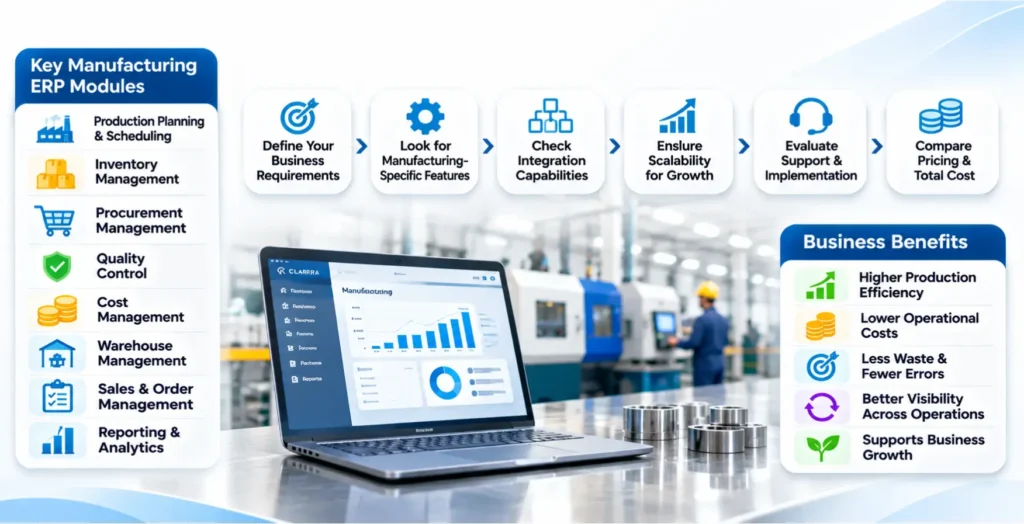
The best ERP for manufacturing is the one that ties production planning, bills of materials, inventory, procurement, costing and accounts into a single database, matches how your factory actually produces, and is simple enough for your team to adopt within a few months. For most factories in Bangladesh, that points to a cloud-based manufacturing ERP with local support, not a heavy global suite built for a different market.
Any manufacturing ERP software you shortlist should pass five tests:
- It fits your production model. Discrete, process, mixed-mode and garment production need different logic.
- It costs every order accurately. Material, labour and overhead should flow into accounts without re-entry.
- It controls raw materials. Material requirements planning (MRP) should stop both stock-outs and overstocking.
- It works where your people work. Supervisors and store keepers need a phone or browser, not a desktop in an office.
- It has support you can reach. Training, on-site help and fast fixes matter more than a long feature list.
This guide explains what a manufacturing ERP system does, which ERP modules for the manufacturing industry matter most, what the market data says, and how to choose and roll out the right system. It also covers the specific needs of an ERP software for garment manufacturing company, since ready-made garments (RMG) dominate Bangladesh’s industrial base.
What Is Manufacturing ERP?
Manufacturing ERP is business software that links everything a factory does, from buying raw materials to shipping finished goods, in one connected system. It replaces separate spreadsheets, paper registers and stand-alone tools with a single source of truth. Many people use the terms manufacturing ERP, manufacturing ERP software and manufacturing ERP systems interchangeably, and in practice they mean the same thing.
The difference from a generic business ERP is depth on the production side. A general ERP handles accounts, sales and HR well. An ERP for the manufacturing industry adds the tools a plant floor depends on:
| Capability | Generic ERP | ERP system for manufacturing industry |
| Bill of materials (BOM) | Rarely included | Multi-level BOMs with labour and overhead |
| Production scheduling | Not available | Work orders, routing, capacity planning |
| Material planning | Basic reorder alerts | Full MRP based on orders and stock |
| Costing | Purchase and sales price only | Standard and actual cost per product or order |
| Quality control | Not available | Inspection checkpoints and rejection tracking |
| Shop floor reporting | Not available | Daily output against targets |
Manufacturers also differ in how they produce, and your ERP should match that model:
| Production type | How it works | Typical examples |
| Discrete | Countable units assembled from parts | Furniture, machinery, electronics |
| Process | Ingredients or materials blended in batches or flows | Food, chemicals, pharmaceuticals |
| Mixed-mode | Combines both in one operation | Packaged food, cosmetics |
| Make-to-order, order-wise | Each buyer order runs as its own job with size and colour breakdowns | Garments, leather and footwear |
Why Manufacturers Need ERP: What the Data Shows
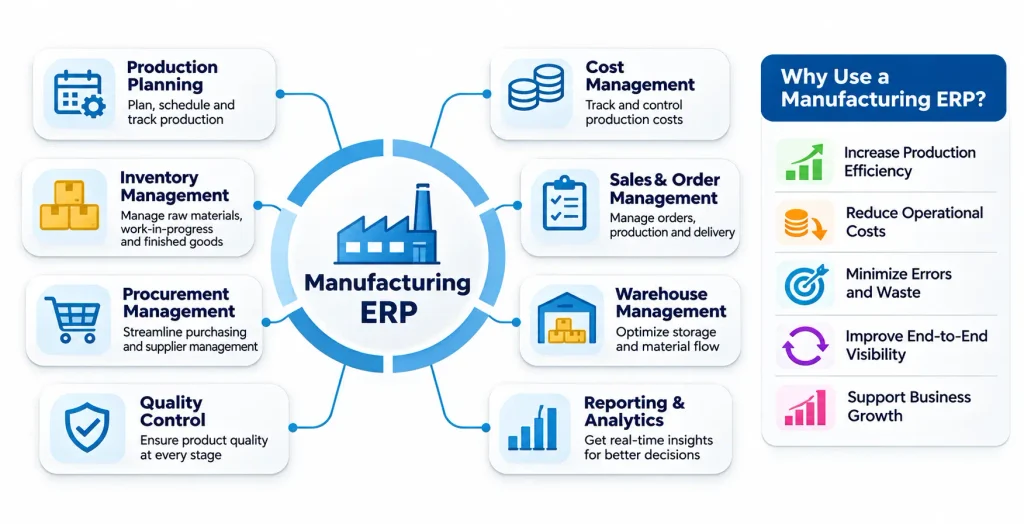
Factories rarely adopt ERP because of a big strategy. They adopt it because spreadsheets stop keeping up: stock counts disagree, costing is a guess and nobody can say where an order stands. The published survey data below shows what changes after go-live.
ERP Implementation: Key Statistics and Business Benefits
| What was measured | Result | Source |
| Manufacturers and distributors rating their ERP project successful or very successful | More than 67% | Mint Jutras survey, 315 firms, Q4 2018 |
| Reported lower IT costs after ERP | 40% of respondents | Mint Jutras via IndustryWeek |
| Reported lower inventory levels | 38% of respondents | Mint Jutras via IndustryWeek |
| Reported shorter cycle time | 35% of respondents | Mint Jutras via IndustryWeek |
| Reported less staff time on manual data entry | 32% of respondents | Mint Jutras via Manufacturing.net |
| Small manufacturers using spreadsheets before ERP | 64% | MRPeasy, 70 customer case studies |
| Small manufacturers lacking operational visibility before ERP | 74% | MRPeasy, 70 case studies |
| Reported better inventory accuracy after ERP | 82% | MRPeasy, 70 case studies |
| Reported less administrative work after ERP | 81% | MRPeasy, 70 case studies |
| Median implementation time for small manufacturers | 2 months | MRPeasy, 70 case studies |
| Average gain in inventory tracking accuracy | 58% | MRPeasy customer survey, late 2025 |
| Average gain in on-time delivery | 37% | MRPeasy customer survey, late 2025 |
Two honest notes on this data. The Mint Jutras survey is from 2018, so treat it as a directional benchmark. The MRPeasy figures come from one vendor’s own customers (small manufacturers in North America, Europe and Asia-Pacific, median 15 employees), and the vendor itself notes the sample may overrepresent successful projects. Read both as indicative, not as a guarantee. The pattern, though, is consistent across both: better stock accuracy, less manual work and faster cycles.
Cost of a weak system is also measurable. A PwC and MAPI survey of 75 manufacturers found that 37% called their core ERP not very effective or ineffective, and those firms saw average annual margin erosion of 3.5%, while firms with effective systems grew margins by 2%. Buying an ERP is not enough; choosing and running the right one is what pays off.
Manufacturing ERP Market Snapshot: Size, Growth and Who Is Buying
The global manufacturing ERP market is growing at roughly 8% to 14% a year, depending on which research firm you read, and Asia-Pacific is the fastest-growing region. Market-size figures differ widely because each firm defines the scope differently, so it helps to see the range rather than trust a single number.
| Research firm | 2025 size (USD) | Forecast (USD) | CAGR |
| Mordor Intelligence | 5.91 billion | 10.17 billion by 2031 | 9.84% (2026-2031) |
| PMarket Research | 26.45 billion | 46.58 billion by 2032 | 8.42% (2025-2032) |
| TrendX Insights | 18.47 billion | 62.00 billion by 2034 | 14.4% (2026-2034) |
The direction is the same in every report: steady double-digit-adjacent growth. This guide uses Mordor Intelligence for the segment data below because its full report was available to review.
| Segment (Mordor Intelligence) | Latest share or growth | What it tells you |
| Deployment: cloud | 55.40% of 2025 spending | Cloud is already the majority choice |
| Deployment: hybrid | 18.00% CAGR to 2031 | Growing faster than the market overall |
| Company size: large enterprises | 58.30% of 2025 revenue | Large firms still spend the most |
| Company size: SMEs | 17.00% CAGR, 2026-2031 | Smaller factories are adopting fastest |
| Production mode: discrete | 60.00% of 2025 implementations | Most deployments are assembly-style |
| Production mode: mixed-mode | 11.50% CAGR to 2031 | Demand for blended models is rising |
| Industry: automotive | 25.00% of 2025 spending | Largest single vertical |
| Industry: electronics and high-tech | 10.70% CAGR to 2031 | Fastest-growing vertical |
| Region: North America | 38.60% of 2025 revenue | Largest regional market |
| Region: Asia-Pacific | 12.80% CAGR to 2031 | Fastest-growing region |
Mordor also reports that subscription pricing and industry-specific cloud suites have cut typical SME implementation from around 18 months to roughly 8 weeks. For a mid-sized factory in Dhaka, Gazipur or Chattogram, this is the practical takeaway: the market is moving toward cloud-based, modular manufacturing ERP software that smaller plants can afford and launch quickly.
Manufacturing in Bangladesh: Why ERP Matters Here
Bangladesh’s factory economy is built on garments, and garment margins are thin. When one export sector supplies more than 80% of exports, small gains in planning, costing and delivery add up to large numbers. That is the local case for manufacturing ERP.
| Indicator | Figure | Source |
| RMG exports, FY2024-25 | US$39.35 billion, up 8.84% | Apparel Resources, citing EPB |
| Knitwear exports, FY2024-25 | US$21.16 billion, up 9.73% | Apparel Resources, citing EPB |
| Woven exports, FY2024-25 | US$18.19 billion, up 7.82% | Apparel Resources, citing EPB |
| RMG share of total exports | Above 80% (81.49% of US$48.28 billion in FY25) | The Financial Express |
| RMG share of GDP | About 8.5% to 10.5%, depending on the measure; Bangladesh Bank put it at 8.52% of nominal GDP in FY25 | Apparel Resources |
| Share of manufacturing employment | Nearly 36% | Dhaka Tribune |
| Garment factories | About 3,320 (Mapped in Bangladesh) to about 4,500 (BGMEA estimate) | Dhaka Tribune |
| Domestic value addition in RMG | About 63% | Dhaka Tribune |
Sources differ on GDP share and factory counts because they use different definitions, so quote the range, not a single number, if you reuse these figures.
The pressure on factories is rising, not easing. Bangladesh Bank data showed RMG export growth slowing in the first quarter of FY2025-26 as trade policy shifted and global demand softened. At the same time, buyers want more proof: one Experience Group director told Apparel Resources that buyers already ask for digitised quality logs and roll-wise traceable data. A factory that cannot produce that data from a connected system will struggle to win repeat orders.
Digital tools are already paying off in local plants. These results were reported by the factories or their technology vendors, so treat them as case examples, not averages:
| Factory or tool | Reported result |
| Azim Group, Coats Digital planning software | 15% improvement in planning efficiency |
| Dressmen Ltd, manufacturing execution system | 4% to 5% higher efficiency and 30% fewer middle-management roles |
| A Dhaka knitwear factory, JUKI JaNets line monitoring (2025) | 12% higher line productivity |
| Sector-wide, digital tools combined with lean and TQM | Defects per hundred units moving from about 12% toward 10% to 11% |
A founder quoted in the same feature said Bangladeshi garment makers have been quick to adopt ERP and digital monitoring, while AI adoption is still early. In other words, ERP is the foundation; most advanced tools plug into it.
ERP Modules for the Manufacturing Industry: What You Actually Need
A good manufacturing ERP is a set of connected modules sharing one database, so an entry made on the shop floor reaches procurement and accounts without retyping. The table below lists the core ERP modules for the manufacturing industry, what each solves, and how CLARRA ERP covers it based on its published module list.
Essential ERP Modules for the Manufacturing Industry: Functions, Benefits, and CLARRA ERP Coverage
| Module | What it does | Problem it solves | CLARRA ERP coverage |
| Production planning and scheduling | Creates production orders, assigns workforce and tracks progress on the floor | Missed delivery dates and idle lines | Production Planning; Production & Assembly |
| Bill of materials (BOM) | Defines every material, labour step and overhead for a product | Wrong consumption and guesswork costing | Multi-level BOMs with labour and overhead breakdowns |
| Material requirements planning (MRP) | Turns orders and stock into a purchase and production plan | Stock-outs and overstocking | Built-in MRP |
| Inventory and warehouse | Tracks raw materials, work in progress and finished goods by location | Mismatched stock counts and lost materials | Warehouse Management; inventory control |
| Procurement and vendors | Handles purchase orders, local and foreign sourcing, vendor records | Late buying and unmanaged supplier payments | Local and Foreign Procurement; Vendor Management |
| Product costing | Calculates material, labour and overhead cost per product or order | Not knowing which orders make money | Product costing with dispatch of finished goods |
| Quality and QA | Records inspection results, rejects and rework | Defects found late, after shipment | Production and QA module |
| Sales, dispatch and export | Manages orders, invoicing, collections and export realisation | Slow collections and manual invoicing | Sales and Collection; Export & Realization |
| Accounts, finance and MIS | Posts every transaction to the chart of accounts and reports on it | Month-end reconciliation and delayed numbers | Accounts; Finance; MIS Reporting |
| HR and payroll | Manages attendance, leave, payroll and performance | Wage errors and manual attendance sheets | Time & Attendance; Leave; Payroll; KPI |
Two extras are worth asking about during demos. The first is mobile or browser access for supervisors and store keepers. The second is reporting that lets owners see output, stock and cash position on one screen instead of waiting for end-of-month sheets.
ERP Software for a Garment Manufacturing Company
An ERP software for a garment manufacturing company must think in styles, buyer orders, sizes and colours, not in generic “products.” Fabric is the biggest cost, deadlines are fixed by the buyer, and every order is a small project. A system built for discrete assembly will usually fall short on these points.
Material cost alone explains the stakes. Imports of cotton, synthetic fibre, yarn and fabric were equal to 39% of RMG export earnings in the second quarter of FY25, according to Bangladesh Bank data reported by The Daily Star. Saving even a small share of that material is real money. Apparel Resources reports that automated nesting systems report 2% to 3% better fabric utilisation globally, which for a factory using 2,000 tonnes of knit fabric a year means roughly 40 to 60 tonnes saved.
Key ERP Requirements for Garment Manufacturing Companies: Features, Benefits, and Vendor Evaluation Questions
| Garment-factory need | Why it matters | What to ask the ERP vendor |
| Order-wise and style-wise tracking | Each buyer PO has its own materials, deadline and margin | Can I see cost and progress per order, style and buyer? |
| Size and colour breakdowns | Consumption and cutting plans differ by size and colour | Does the system handle size-colour matrices in orders, BOMs and stock? |
| Merchandising and sampling | Samples, approvals and consumption sheets drive the final cost | Is there a merchandising and sample-development module linked to costing? |
| Fabric and trims control | Fabric rolls, trims and accessories are the largest spend | Can I track issue, return and balance by roll and by order? |
| Cutting and wastage analysis | Marker efficiency decides fabric yield | Does it compare planned and actual consumption by order? |
| Line efficiency and industrial engineering | Standard minute values and line balancing set output targets | Is there an IE function with daily output against target? |
| Quality and defect tracking | Rework and rejects eat margin and delay shipment | Can I log defects per line and view defects per hundred units? |
| Export documentation and realisation | LC, back-to-back LC and shipment cycles tie up cash | Does it track export realisation and link to accounts? |
| Buyer compliance and traceability | Buyers increasingly ask for digital records | Can it produce order-wise, roll-wise or lot-wise reports on demand? |
CLARRA ERP’s published module list includes Merchandising, Sample & Product Design, Industrial Engineering (IE), Production & Assembly, Warehouse Management and Export & Realization, all posting to one chart of accounts. If you run a garment unit, ask for a demo built around one of your real orders, from buyer PO to export realisation, and judge the system on that walk-through.
How to Choose the Best ERP System for Manufacturing
The best ERP system for manufacturing is the one that scores highest on your own priorities, not the one with the longest feature list. Start with a short list of three vendors, define one real production order to test, and score each system against the same criteria.
| Criterion | Suggested weight | What good looks like |
| Fit for your production model | 20% | Handles your BOM structure, order-wise or batch production without workarounds |
| Costing and accounts integration | 15% | Every issue, wage and overhead posts to accounts automatically |
| Inventory and MRP | 15% | Accurate stock by location and a purchase plan driven by real orders |
| Local support and training | 15% | Named account manager, phone and on-site support, refresher training |
| Ease of use and mobile access | 10% | Supervisors and store staff can use it on a phone or browser |
| Implementation time and cost | 10% | Clear scope, fixed timeline, no surprise add-on fees |
| Data security | 10% | Access controls, audit trails and clear data-handling policy |
| Scalability | 5% | New modules, users and units can be added without re-platforming |
These weights are a starting point. A multi-unit exporter might raise costing and compliance; a small workshop might raise ease of use.
Deployment is the next decision. Mordor Intelligence found that cloud already held 55.40% of manufacturing ERP spending in 2025, while hybrid deployments are growing at 18.00% a year.
| Deployment | Best for | Strengths | Watch-outs |
| Cloud or browser-based | Most SMEs and multi-site factories | Lower upfront cost, access from any device, no server upkeep | Needs reliable internet; check data-hosting terms |
| On-premise | Plants with strict internal data rules | Full control of servers and data | Higher capital cost and an in-house IT team |
| Hybrid | Firms mixing sensitive and shared data | Keeps critical data on-site while using cloud tools | More complex to design and support |
Vendor type also shapes the experience. This is a general pattern, not a rule for every product:
| Vendor type | Typical strength | Typical trade-off |
| Global suites such as SAP, Oracle, Microsoft, Infor and Epicor (the five leaders named by Mordor) | Deep functionality, global presence | Higher cost, longer projects, more consultants |
| Local industry-specific ERP | Fit for local processes, faster rollout, nearby support | Check depth for very complex or multinational needs |
| Basic inventory or accounting tools | Cheap and quick to start | Little or no production planning, BOM or MRP |
Finally, ask every vendor for references from factories like yours, a written implementation plan, and a trial walk-through of your own data.
How to Implement a Manufacturing ERP: Steps and Common Mistakes
Most implementation problems come from preparation, not software. In MRPeasy’s study of 70 small-manufacturer case studies, 25% named data cleanup and migration as a major challenge and 19% named employee resistance. A phased plan keeps both under control.
- Set three goals. Pick the pains you want gone, such as stock mismatches, unclear order costs or late deliveries.
- Map your processes. Write down how an order moves from buyer or customer to dispatch, including who touches it.
- Clean your data. Prepare the item list, bills of materials, opening stock, vendor and customer records before go-live.
- Shortlist and test. Run each vendor through one real order from your own factory.
- Roll out in phases. Start with inventory, procurement and accounts, then add production planning and costing.
- Train by role. Train store keepers, supervisors, merchandisers and accountants on their own screens, with a champion on each shift.
- Run in parallel, then switch. Use the old and new system side by side for one cycle, then retire the old one.
- Review monthly. Track stock accuracy, on-time delivery and cost variance, and fix gaps while they are small.
Timelines depend on company size. In the same MRPeasy study, median implementation time rose with headcount:
| Company size | Median implementation time |
| 10 or fewer employees | 1 month |
| 11 to 25 employees | 2 months |
| 26 to 50 employees | 3 months |
| 51 or more employees | 6 months |
These are small-manufacturer figures from a cloud vendor’s customers. A larger multi-unit factory should plan longer and phase by unit.
The most common mistakes are easy to avoid:
- Migrating messy data. Wrong BOMs and stock counts produce wrong plans from day one.
- Customising too early. Use standard workflows first, then change only what truly differs.
- Leaving the floor out. If supervisors and store staff do not enter data, the system shows fiction.
- No internal owner. Name one person who owns the project and has authority to decide.
- Treating go-live as the finish. The same MRPeasy study lists limited time and internal alignment among the top hurdles, so keep reviewing after launch.
Why CLARRA ERP for Manufacturing ERP in Bangladesh
CLARRA ERP, built by iTech Velocity, is a cloud-based ERP made for Bangladeshi businesses, with a dedicated manufacturing ERP solution and a separate track for leather and footwear. It connects production, procurement, inventory, sales and accounts in one system, so the numbers the owner sees match what happens on the floor.
| What a factory needs | How CLARRA ERP addresses it |
| Control over production | Production orders, scheduling, workforce assignment and daily output tracking against targets |
| Raw material control | Material requirements planning to keep supply steady without overstocking |
| Accurate product cost | Multi-level bills of materials with labour and overhead breakdowns, plus product costing |
| One set of books | Every module posts to the chart of accounts automatically, with no month-end reconciliation of separate files |
| Access on the floor | Progressive Web App that runs in a browser on any phone, tablet or laptop, with nothing to install |
| Data protection | Built-in AI that works inside the system, so company data is not sent to outside servers, backed by ISO certification, according to CLARRA ERP |
| Help when it matters | L1 to L5 support, including an account manager, WhatsApp group, phone support, on-site visits and refresher training |
CLARRA ERP also covers the wider business through its published modules for supply chain and commercial work, sales and distribution, accounts, finance and asset management, and human capital management. The company lists customers and operations across Bangladesh, with service also offered in the UAE, KSA and Kuwait.
Pricing depends on users, modules and business size, so CLARRA ERP quotes each project individually. For related reading, see CLARRA ERP’s guides to the ERP system in Bangladesh and ERP for the construction industry.
Frequently Asked Questions About Manufacturing ERP
What is the best ERP for manufacturing?
The best ERP for manufacturing is the system that fits your production model, costs every order accurately, controls raw materials and is supported locally. A garment exporter, a food processor and a machine shop need different strengths, so test each shortlisted system with one of your own real orders.
What is a manufacturing ERP system?
A manufacturing ERP system is software that connects production planning, bills of materials, inventory, procurement, costing, sales and accounts in a single database. It replaces separate spreadsheets and paper registers with one live view of the factory.
Which ERP modules are essential for the manufacturing industry?
The essential ERP modules for the manufacturing industry are production planning, bill of materials, material requirements planning, inventory and warehouse, procurement, product costing, quality control, sales and dispatch, accounts and finance, and HR with payroll.
What is the best ERP software for manufacturing in Bangladesh?
The best choice for a Bangladeshi factory is usually a cloud-based ERP with local support and an understanding of local workflows such as order-wise production and export realisation. CLARRA ERP is one such option, with a dedicated manufacturing solution; compare it against two other vendors using the scoring table above.
What should ERP software for a garment manufacturing company include?
It should handle buyer orders by style, size and colour, merchandising and sampling, fabric and trims control, cutting wastage, line efficiency, defect tracking, export documentation and order-wise costing, all linked to accounts.
How long does it take to implement a manufacturing ERP?
In MRPeasy’s study of 70 small-manufacturer case studies, the median was 2 months, ranging from a median of 1 month for companies with 10 or fewer employees to 6 months for those with 51 or more. Larger or multi-unit factories should plan for longer.
Should a factory choose cloud or on-premise ERP?
Most small and mid-sized factories choose cloud ERP for lower upfront cost and access from any device. Mordor Intelligence reports cloud held 55.40% of manufacturing ERP spending in 2025. On-premise or hybrid suits firms with strict internal data rules.
How fast is the manufacturing ERP market growing?
Mordor Intelligence projects the market to grow from US$6.36 billion in 2026 to US$10.17 billion by 2031, a 9.84% annual rate, with Asia-Pacific the fastest-growing region at 12.80%. Other research firms publish different sizes, but all show steady growth.
Can small factories afford ERP?
Yes. Subscription pricing and industry-specific cloud suites have lowered the entry barrier, and Mordor Intelligence expects small and medium manufacturers to be the fastest-growing buyer group, at 17.00% a year. Costs depend on users and modules, so ask each vendor for a written quote.
What results can manufacturers expect from ERP?
Surveys report better inventory accuracy, less manual work and faster cycle times. For example, 82% of small manufacturers in MRPeasy’s study reported better inventory accuracy, and 38% of firms in a Mint Jutras survey reported lower inventory levels. Results vary by company and depend on how well the system is rolled out.
Conclusion: Choosing the Best ERP for the Manufacturing Industry
The best ERP software for manufacturing is the one your team will actually use, one that costs each order correctly and keeps stock, purchasing and accounts in agreement. Whether you compare global suites or local ERP software for the manufacturing industry, judge each option on your own production model, your data and the support behind it.
- Define your top three problems before you look at any demo.
- Match the system to how you produce: discrete, process, mixed-mode or order-wise garment production.
- Score vendors on one real order, using the same criteria for each.
- Roll out in phases, clean your data first and review results monthly.
If you run a factory in Bangladesh and want to see how a connected system handles production, costing and accounts, book a free CLARRA ERP demo, email: info@clarra.tech or call +880 1317-992233.