
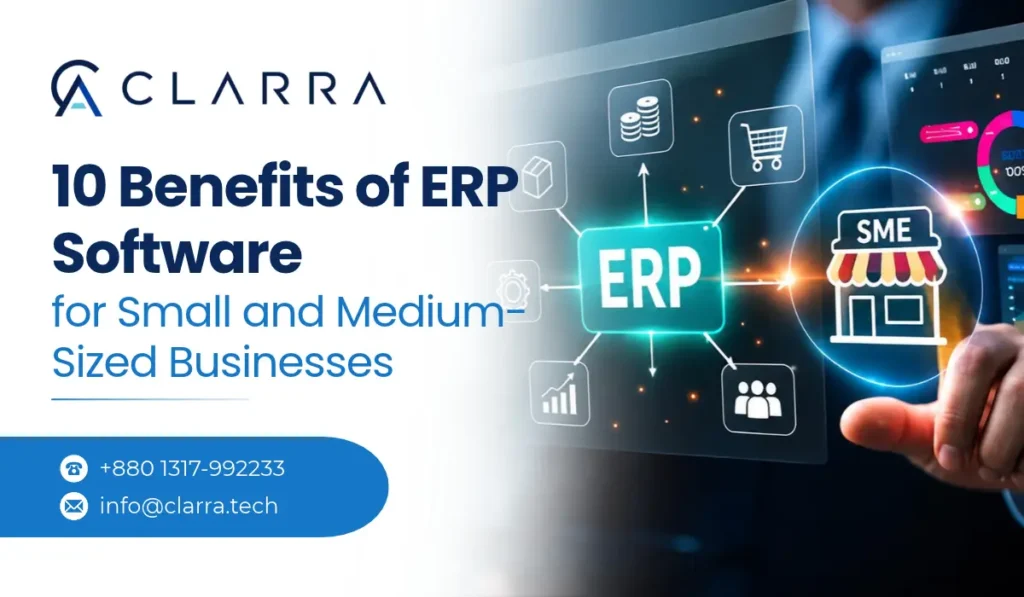
Benefits of ERP Software for SME means one system that runs your accounting, stock, sales, purchasing and HR together, so you stop chasing numbers across five different spreadsheets. That’s really the whole idea. At Clarra ERP, we help smaller companies make the switch without the usual chaos.
The biggest benefits of ERP software are less manual work, one version of the truth, lower costs, tighter inventory, clearer cash flow, faster decisions, easier compliance, happier customers, room to grow, and access from anywhere.
What Is ERP Software for Small Business?
ERP stands for Enterprise Resource Planning. ERP software for small business ties every department to one shared database. Record a sale and the stock count drops, the invoice is created, and the accounts update. Nobody types it twice.
Older systems were heavy, slow and expensive. Today’s SME ERP software is different. It’s usually cloud-based, priced by subscription, and sold in modules, so a 15-person shop can start small instead of buying everything at once.
Why ERP for SME Is Worth a Serious Look in 2026
Small and medium businesses carry a huge share of the economy. In Bangladesh, commonly cited estimates put their contribution at around a quarter of GDP. Yet plenty of them still run on Excel, paper registers and a billing tool that doesn’t talk to anything else.
You’ve probably seen how that goes. Someone updates one file and forgets the other. A report takes three days. A customer is promised stock you don’t have. None of it is dramatic on its own, but it adds up every month.
10 Benefits of ERP Software for Small and Medium-Sized Businesses
1. Less Repetitive Work
Re-entering orders, matching invoices, building the weekly report by hand: ERP automates most of it. Your team gets those hours back for work that actually moves the business.
2. One Source of Truth
Finance, sales and the warehouse all see the same numbers. The “which version is right?” conversation just disappears.
3. Lower Running Costs
Fewer errors, fewer duplicate tools, less overtime. Good, affordable ERP solutions for SMEs often pay for themselves through savings on rework, waste and overstock alone.
4. Better Inventory Control
You see stock in real time, set reorder alerts, and learn what really sells. That means fewer empty shelves and less cash stuck in slow-moving items.
5. Clearer Cash Flow
Automated invoicing and payment tracking show who owes you what, and when. You catch late payers early instead of discovering the problem at month-end.
6. Faster, Better Decisions
Dashboards show sales trends, margins and team performance as they happen. Managers stop guessing and start checking.
7. Easier Compliance
Tax records, audit trails and statutory reports come from the same clean data. Your accountant spends less time hunting for paperwork, and you carry less risk.
8. Happier Customers
When your team can see the full order history and a reliable delivery date, customers notice. Quick, accurate answers build trust, and trust brings repeat orders.
9. Room to Grow
Opening a second branch? Adding a manufacturing line? A solid system lets you add users and modules without starting over.
10. Access from Anywhere
Cloud ERP for small businesses lets you check numbers from a phone on the way to a supplier. There are no servers to maintain, updates arrive automatically, and backups run in the background. That’s why cloud ERP for SME owners is now the default choice for many of the top-performing companies we speak with.
Best ERP for SME: How to Choose Without Getting Burned
If you’re hunting for the best ERP software for small business, here’s the honest truth: there’s no single winner. The right system depends on your industry, team size and budget.
How to Choose ERP Software for Small Business
- Write down your real problems. Stock mismatches? Slow invoicing? Start there, not with a feature list.
- Check industry fit. A retailer and a manufacturer need very different modules.
- Go cloud if you can. It cuts IT costs and makes remote work easy.
- Count the full cost. Licenses, setup, training and support all count, not just the monthly fee.
- Test with your own data. Ask for a demo built around your actual workflow.
- Judge the vendor. A professional partner helps with data migration, trains your staff, and still picks up the phone after go-live.
ERP Software for Small Business in Bangladesh
Running a business in Dhaka or Chattogram comes with its own pressures: VAT and tax rules, multiple branches, imported stock, and demand that shifts fast. That’s why interest in ERP for SME owners here keeps climbing.
When you compare ERP software for small business in Bangladesh, look hard at local compliance support, onboarding that works in Bangla, and a team you can actually reach. In our experience, that matter more than a long feature list. Many ERP solutions for SMEs look great in a demo and fall apart on local tax reporting.
Mistakes We See Over and Over
- Choosing on price alone
- Skipping staff training
- Moving messy data into the new system without cleaning it first
- Switching on every module at once (start with the one that hurts most)
FAQs About ERP for SME
What is the best ERP software for small and medium businesses?
The one that fits your industry, budget and growth plans. Look for cloud access, modular pricing, strong local support and a vendor you can trust.
How much does ERP cost for a small business?
It depends on users, modules and deployment. Cloud subscriptions usually cost less upfront than on-premise systems. Always ask for the total cost, including setup, training and support.
Is cloud ERP safe?
Yes, with a reputable vendor. Good providers use encryption, access controls and automatic backups, often better than a small company could manage on its own server.
How long does implementation take?
Usually a few weeks to a few months, depending on how clean your data is and how involved your team gets.
Can ERP grow with my business?
Yes. You can add users, branches and modules as you expand.
I already use accounting software. Do I still need ERP?
Accounting tools cover finances only. ERP connects finance with inventory, sales, purchasing and operations.
Conclusion
The real benefits of ERP software for SME teams isn’t just saved time. It’s accuracy, control, and the confidence to grow without everything breaking. Pick a system that fits how you work, and a professional partner you can lean on.
Want to see it with your own numbers? Visit Clarra ERP and book a free consultation and demo.