
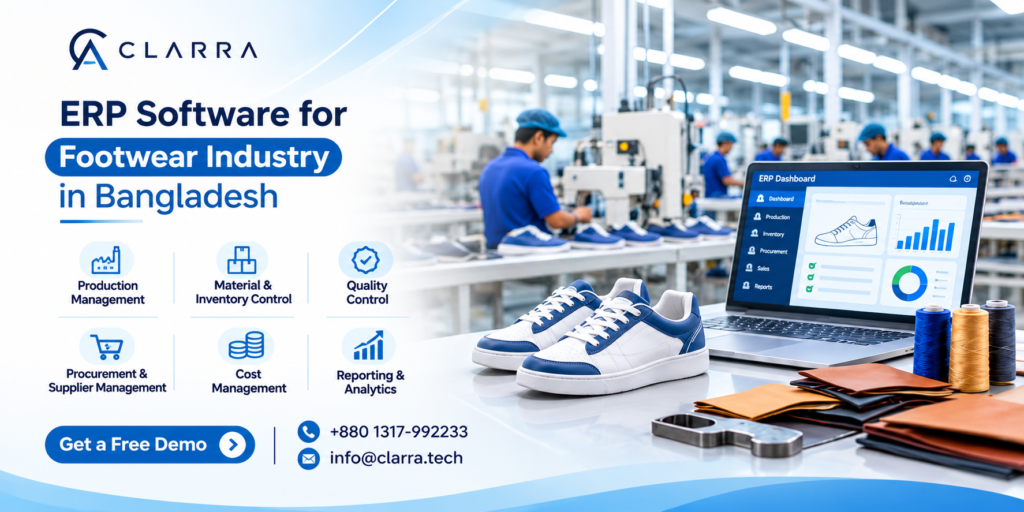
ERP software for footwear industry teams isn’t glamorous, but it’s what stops a shoe factory from running on WhatsApp messages, half-updated Excel sheets and somebody’s memory of what the buyer said last Tuesday.
If you manage a factory in Gazipur, Savar, Dhaka, Chattogram, or anywhere in Bangladesh, you know the feeling. An order lands for 12,000 pairs across six sizes and three colors. Purchasing needs the sole count by tomorrow. Finance wants the real cost per pair. Nobody’s numbers match. Leather and footwear are one of Bangladesh’s top export sectors after garments, and buyers aren’t getting any more patient. We’re the team at CLARRA ERP, and this guide covers what a footwear ERP actually does, what to look for, and where factories usually go wrong when they pick one.
A footwear ERP ties orders, materials, production, stock and accounts into one system. You enter an order once, and everyone from the store keeper to the managing director works from the same numbers.
What Is ERP Software for Footwear Industry Operations?
ERP software for footwear industry operations is one system built around the way shoes actually get made. People search for it under all sorts of names: footwear ERP software, ERP footwear, footwear manufacturing ERP. They all point to the same idea.
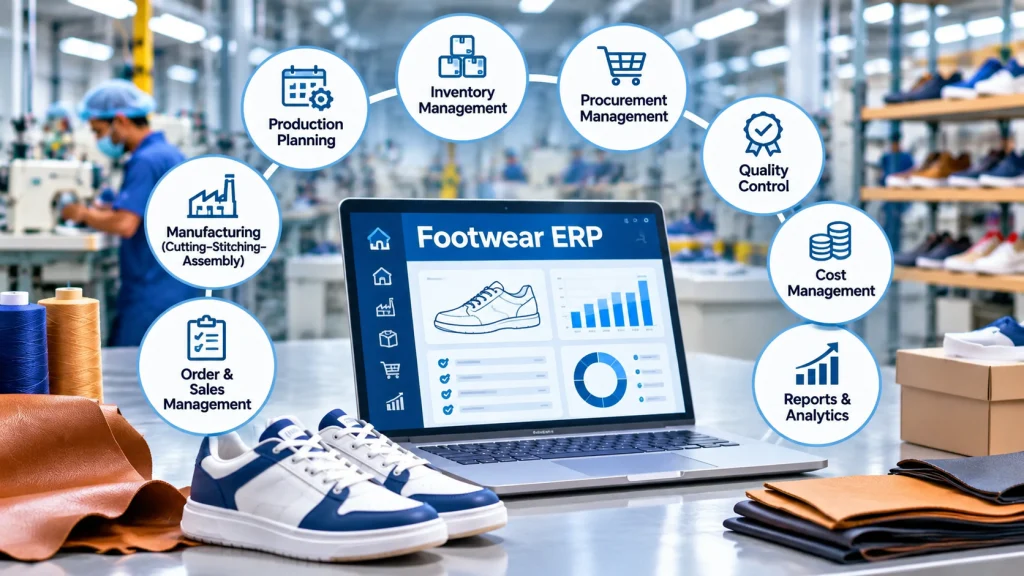
Why not just use ordinary accounting software? Because a shoe isn’t one product. A single style can run in eight or ten sizes, a few colors, and dozens of parts: uppers, linings, soles, insoles, laces, eyelets, cartons. A generic tool can’t tell you how much leather a whole order needs once wastage is counted. A proper system can. Here’s what it normally covers:
- Size-color breakdown. Key in the buyer order once and it splits into size runs for you.
- Bill of materials (BOM). Exact material needs per pair, with wastage built in.
- Material planning. What to buy, how much, and by which date.
- Stage tracking. Cutting, stitching, lasting, finishing and packing, with work in progress visible at each step.
- Quality records. Defects logged by line, stage and style.
- Costing. The real cost per pair, before you ship and after.
Why Bangladesh Needs ERP Software for Footwear Industry Now
Footwear ERP in Bangladesh used to be something only the biggest exporters bothered with. That’s changed. Mid-sized factories now feel the same squeeze:
- Raw material and wage costs keep climbing, and margins get thinner every season.
- Buyers want shorter lead times, and audits keep getting stricter.
- Imported materials, back-to-back LCs and bonded warehouse records all have to stay accurate.
- Excel files get copied, renamed and edited by three people at once. Mistakes follow.
Factories that move to ERP software for footwear industry workflows tend to quote faster, run short of materials less often, and see their margins sooner. The reason is simple. Purchasing, stores, production and finance finally read from the same page.
So, is it worth it? If you run several styles, buyers or lines, yes. If you make one product for one customer, maybe not yet.
Key Features of Footwear Manufacturing ERP
Production and BOM control
Everything starts with the BOM. In ERP software for footwear manufacturing, change a style and the material needs, purchase suggestions and costing all update together. Good shoe manufacturing software also shows planners how much capacity each line has left, so nobody promises a delivery date the floor can’t meet.
Inventory and purchasing
Shoe factory management software should track leather, synthetics, soles, chemicals and accessories by lot, location and supplier. Reorder alerts and goods receipt notes sound boring. They’re also what stops a line from standing idle for a missing zipper.
Costing and accounts
Footwear manufacturing ERP software only earns its keep when production talks to finance. Look for automatic cost sheets, wastage reports, supplier payables, LC tracking and VAT-ready invoices that feed straight into the ledger.
Dashboards
Owners rarely want fifty reports. They want to know what shipped, what’s late and where defects are rising. Footwear production management software puts that on one screen, and a phone-friendly view means you can check it from the floor or from home.
Local fit
Manufacturing ERP software in Bangladesh needs to handle Bangla and English, local tax rules and the paperwork exporters deal with every week. Footwear ERP software in Bangladesh that skips these details just creates new manual work.
How to Choose the Best ERP Software for Footwear Industry
The best ERP software for footwear industry buyers isn’t the one with the longest feature list. It’s the one your supervisors will still be using six months after go-live. Here’s what to check:
- Industry depth. Does it handle size-color matrices and multi-part BOMs out of the box, or does it need heavy customizing?
- Ease of use. Can a line supervisor learn it in a few days?
- One database. Production, stock, HR and accounts should share it.
- Local support. A professional team in Bangladesh, reachable in your time zone and your language.
- Room to grow. A second factory or a new line shouldn’t mean starting over.
- Real cost. Add up license, customization, training and support. The quote is rarely the whole bill.
One tip: ask every vendor to run a demo with your own style and BOM. Slick sample data proves nothing. Your data will show whether the system fits.
Rolling It Out and What You’ll Get Back
A professional rollout of ERP software for footwear industry projects usually runs in five steps:
- Study how orders, purchases and production flow today.
- Clean up item lists, BOMs, suppliers and opening stock.
- Configure approvals, costing rules and reports, then test them.
- Train each department on its own daily tasks.
- Go live, run alongside the old method briefly, and review.
Where does the payback come from? Usually four places: less wasted material, fewer production delays, a faster month-end close, and pricing decisions based on real cost. Write down your numbers for each before launch. Otherwise, the improvement is just a feeling.
Why CLARRA Is a Trusted ERP Software for Footwear Industry Partner
CLARRA builds ERP software for footwear industry clients with day-to-day use in mind, not just a good demo. Three things guide how we work:
- We start on your floor. Your processes and buyer requirements come first, not a generic template.
- We’re upfront. Scope, timeline and pricing are agreed in writing, with no surprise modules later.
- We stay after go-live. A local team helps with reports, upgrades and the new requests that always show up.
Trust comes from delivery, so we begin with a discovery session and a demo built on your own data. You can judge the system before you commit a taka.
Frequently Asked Questions
What does a footwear ERP system do?
It links orders, materials, production, quality, stock and finance in one platform. Owners get live visibility and an accurate cost per pair.
Is there suitable ERP for small shoe factories in Bangladesh?
Yes. Modular systems let small units start with stock, purchasing and costing, then add production later.
How long does implementation take?
It depends on factory size, how clean your data is, and how much customizing you need. Expect anywhere from a few weeks to a few months.
How is this different from accounting software?
Accounting software records money. A footwear system also manages size runs, BOMs, material planning and production stages, which are what create that money in the first place.
Does it help with buyer audits and traceability?
Yes. Lot-wise material tracking, quality records and order histories make audit questions much quicker to answer.
Conclusion
Picking the right ERP software for footwear industry growth comes down to three things: real industry fit, ease of daily use, and support that actually picks up the phone. The top systems turn scattered files into confident decisions on costing, buying and delivery. If you’d like to see how that looks in your own factory, book a demo with CLARRA ERP.